
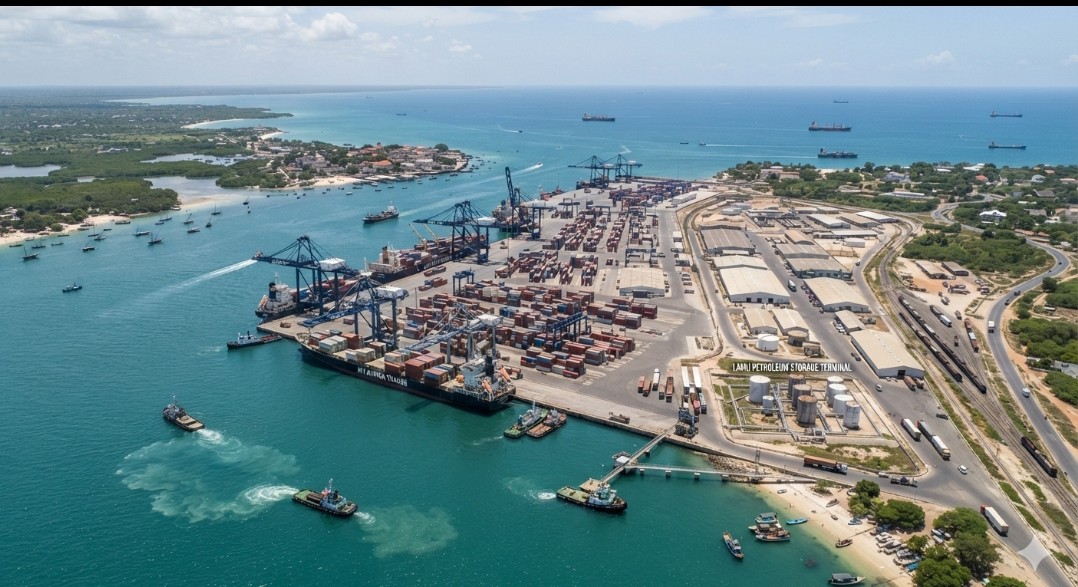
Transformation Is Not About Changing Everything. It’s About Becoming What the Future RequiresThe Lamu Moment: Why Dangote’s Refinery Could Reshape East Africa’s Industrial Economy
By Rayan | Scansarayan
On 30 September 2026, construction officially broke ground on what is planned to become one of Africa’s largest industrial projects: the $16 billion Dangote East Africa Petroleum Refinery in Lamu, Kenya.
The numbers are difficult to ignore.
The planned refinery is designed to process approximately 700,000 barrels of crude oil per day, with completion targeted for 2030. It is expected to produce petroleum products for Kenya and wider East African markets, while the project involves international engineering and technology partners including Engineers India Limited and Honeywell.
But the most important story may not be the refinery itself.
It may be everything that develops around it.
Lamu could become a much larger industrial and logistics proposition than the physical refinery being constructed on its shores.
The refinery is the anchor. The ecosystem is the opportunity.
Large industrial projects rarely exist in isolation.
A refinery requires crude supply, marine infrastructure, storage, transportation, engineering, equipment, maintenance, security, technology, skilled labour, warehousing and financial services.
It creates demand for businesses that move cargo, manage vessels, maintain machinery, provide industrial services, operate warehouses, develop infrastructure and connect manufacturers to regional markets.
Kenya’s State Department for Shipping and Maritime Affairs has already identified potential effects across vessel traffic, petroleum logistics, port services and specialised maritime skills. It has also highlighted possible demand for pilotage, towage, bunkering, ship agency, cargo handling, marine surveying, freight forwarding, ship repair, marine engineering, storage, pipeline operations and hazardous-material handling.
That is a much larger economic footprint than a refinery alone.
And there is already physical evidence that the ecosystem is beginning to move.
On 26 September, approximately 2,930 tonnes of construction machinery arrived at Lamu Port aboard the MV Da Yang, ahead of the groundbreaking.
The industrial story is therefore no longer entirely theoretical.
Lamu Port could become strategically more important
The refinery is being developed beside a port that was already designed to serve a much larger regional ambition.
Lamu Port forms part of the Lamu Port-South Sudan-Ethiopia Transport (LAPSSET) Corridor, connecting Kenya’s coast with markets and infrastructure extending into the wider region.
The first three berths are operational, while Kenya has been pursuing greater private-sector participation in the development and operation of port assets.
In fact, Kenya Ports Authority documentation has identified the Lamu Port container terminal and Lamu Special Economic Zone among assets proposed for development and operation through public-private partnerships.
That matters.
Because once industrial production, energy infrastructure and maritime logistics begin converging around the same geographic area, the commercial question changes.
It becomes:
Who will build, operate, transport, finance, service and supply the ecosystem?
The Lamu SEZ adds another layer
The opportunity extends beyond petroleum.
Kenya’s investment project catalogue describes the Lamu Special Economic Zone as approximately 12,000 hectares, comprising around 9,000 hectares designated for industrial use and 3,000 hectares for logistics.
The catalogue positions the SEZ for activities including agro-processing, leather, furniture, automotive and logistics, while identifying private development and a BOT PPP model as part of the investment structure. It also records anchor-operator interest involving Morocco’s Marsa Maroc.
This creates an important possibility.
The refinery can become an industrial anchor.
The port can become the maritime gateway.
The SEZ can become the industrial platform.
And the LAPSSET Corridor can connect the system to regional markets.
That is the bigger picture.
The next competition may be for capability
When major infrastructure arrives, attention naturally goes to the headline investment.
But the second-order effects are often where businesses emerge.
Consider the layers:
Energy
Refining, storage, petroleum distribution, pipeline infrastructure, fuel transportation and industrial energy services.
Maritime
Shipping agencies, vessel services, marine engineering, bunkering, port operations, cargo handling and ship maintenance.
Logistics
Project cargo, heavy haulage, warehousing, freight forwarding, customs, fleet management and regional distribution.
Industrial services
Equipment maintenance, fabrication, engineering, safety, inspection, environmental services and specialised contracting.
Technology
Industrial automation, communications, cybersecurity, data infrastructure and digital systems.
Human capital
Engineering, maritime operations, machine operators, technical training, management and specialised professional services.
The scale of an industrial transformation is therefore not measured only by the value of the headline project.
It is measured by how many productive capabilities emerge around it.
East Africa is the real market
One of the most consequential elements of the project is its intended regional reach.
The refinery is being positioned to supply Kenya and neighbouring East African markets, rather than operating simply as a facility serving Lamu or even Kenya alone. Reuters reported that the project is intended to support energy supply across a region stretching from Ethiopia toward Mozambique.
That regional orientation changes the commercial equation.
A company entering the Lamu ecosystem is potentially positioning itself within a wider East African supply chain.
A logistics company may not simply be moving cargo to Lamu.
It could eventually be connecting the coast to inland industrial markets.
A manufacturer may not simply be producing for Kenya.
It could use the SEZ and corridor infrastructure to access regional customers.
A shipping business may not simply be serving one port.
It could become part of a broader maritime network.
This is why regional strategy matters as much as physical infrastructure.
The digital economy will matter too
There is another dimension that is easy to overlook.
Industrial transformation increasingly requires digital visibility.
The companies that win major contracts will need credible websites, strong corporate positioning, clear capabilities, investor-facing communication, technical content, regional market intelligence and digital systems that allow partners and customers to understand what they actually do.
A company can own trucks, warehouses, vessels or industrial equipment and still have a weak market position.
In an increasingly connected African economy, physical capability and digital credibility have to reinforce each other.
This is where the next generation of African businesses can differentiate themselves.
Not simply by owning assets.
But by understanding markets, building institutional credibility and communicating their value clearly.
The opportunity should not be romanticised
There is also a reason to remain analytical.
The refinery faces significant execution requirements, including crude supply, infrastructure, financing, environmental considerations and legal issues. Reuters has previously reported questions around crude sourcing and other project hurdles, while the groundbreaking has taken place amid legal challenges concerning land and environmental concerns.
A groundbreaking ceremony is therefore not the same thing as a completed industrial ecosystem.
The real test will be execution.
Can infrastructure be delivered?
Can supporting businesses scale?
Can the corridor connect efficiently to regional markets?
Can local communities participate meaningfully in the economic opportunity?
Can environmental and social concerns be addressed?
Can Kenya convert a major foreign investment into durable domestic capability?
Those questions will determine the long-term significance of Lamu.
Africa’s next industrial chapter will require African capability
There is something bigger happening here.
For decades, much of Africa’s economic conversation has centred on exporting raw materials and importing finished products.
Industrial projects such as the proposed Lamu refinery represent an attempt to move further along the value chain.
But infrastructure alone does not create industrialisation.
Capability does.
The engineers.
The logistics companies.
The manufacturers.
The financiers.
The technology companies.
The entrepreneurs.
The skilled workers.
The businesses willing to build for a market that may take years to mature.
That is where the real opportunity lies.
Lamu is a signal
The Lamu refinery should therefore be watched as more than an energy story.
It is a signal of where Kenya’s northern coastline and the wider East African economy could be heading.
Energy.
Ports.
Logistics.
Manufacturing.
Trade.
Technology.
Infrastructure.
Regional integration.
These sectors are beginning to intersect around one geographic corridor.
The companies that understand that intersection early will be better positioned to identify where value is being created.
The investors that understand it will see more than a refinery.
And the entrepreneurs that understand it may see something even more important:
a market being built before it reaches maturity.
Lamu is not yet the finished story.
It is the beginning of one.
And in Africa’s next industrial chapter, the biggest opportunity may not belong only to those building the headline project.
It may belong to those building everything around it.
—
SCANSARAYAN
INTELLIGENCE. STRATEGY. EXECUTION.
Africa’s next economic opportunities will not simply be discovered.
They will be understood, positioned and executed.
Leave a Reply